
4K60 1×4 HDMI Splitter with Optical + Analog Audio Extraction
Break Audio Out to a Legacy Amp or DSP - S/PDIF Dolby/DTS Bitstream, PCM 2.0 on 3.5mm, 18Gbps 4:4:4 Pass-Through

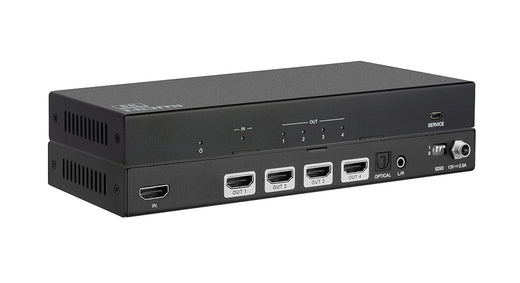
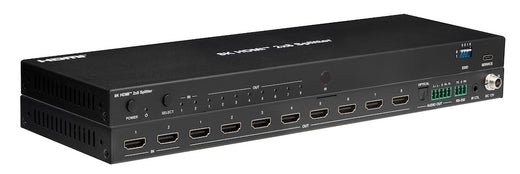
Feeds one 4K60 4:4:4 HDMI source to four displays while handing a clean audio feed off to a legacy amp or DSP — without a separate de-embedder in the rack. Housed in a black metal enclosure and powered by an external 5V/1A supply, this 1×4 distribution amplifier passes the full 18Gbps of HDMI 2.0b to all four outputs with HDCP 2.2 and 1.4 compliance. It is the right choice for boardrooms, signage clusters, lecture halls and media rooms where deterministic EDID, an onboard downscaler and audio breakout matter more than 8K bandwidth or KVM.
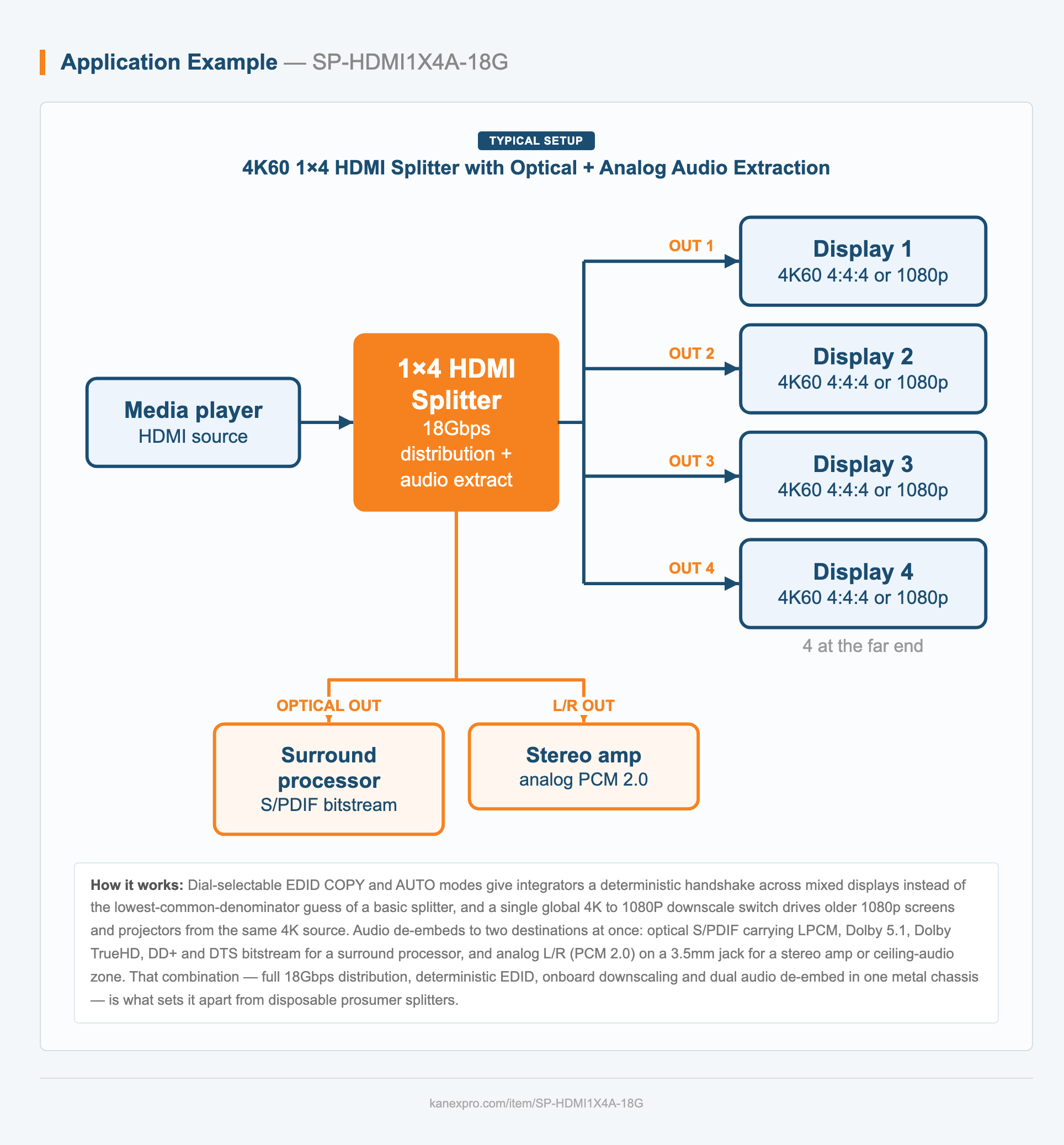
Dial-selectable EDID COPY and AUTO modes give integrators a deterministic handshake across mixed displays instead of the lowest-common-denominator guess of a basic splitter, and a single global 4K to 1080P downscale switch drives older 1080p screens and projectors from the same 4K source. Audio de-embeds to two destinations at once: optical S/PDIF carrying LPCM 2.0/2.1CH and Dolby Digital / DTS 5.1 bitstream for a surround processor, and analog L/R (PCM 2.0) on a 3.5mm jack for a stereo amp or ceiling-audio zone. That combination — full 18Gbps distribution, deterministic EDID, onboard downscaling and dual audio de-embed in one metal chassis — is what sets it apart from disposable prosumer splitters.
- HDCP 2.2 and HDCP 1.4 compliant.
- Supports HDMI resolution up to 4K2K@50/60Hz (4:4:4), per HDMI 2.0b.
- Passes the full 18Gbps of video bandwidth to all four HDMI outputs.
- Extracts digital and analog audio from the HDMI source.
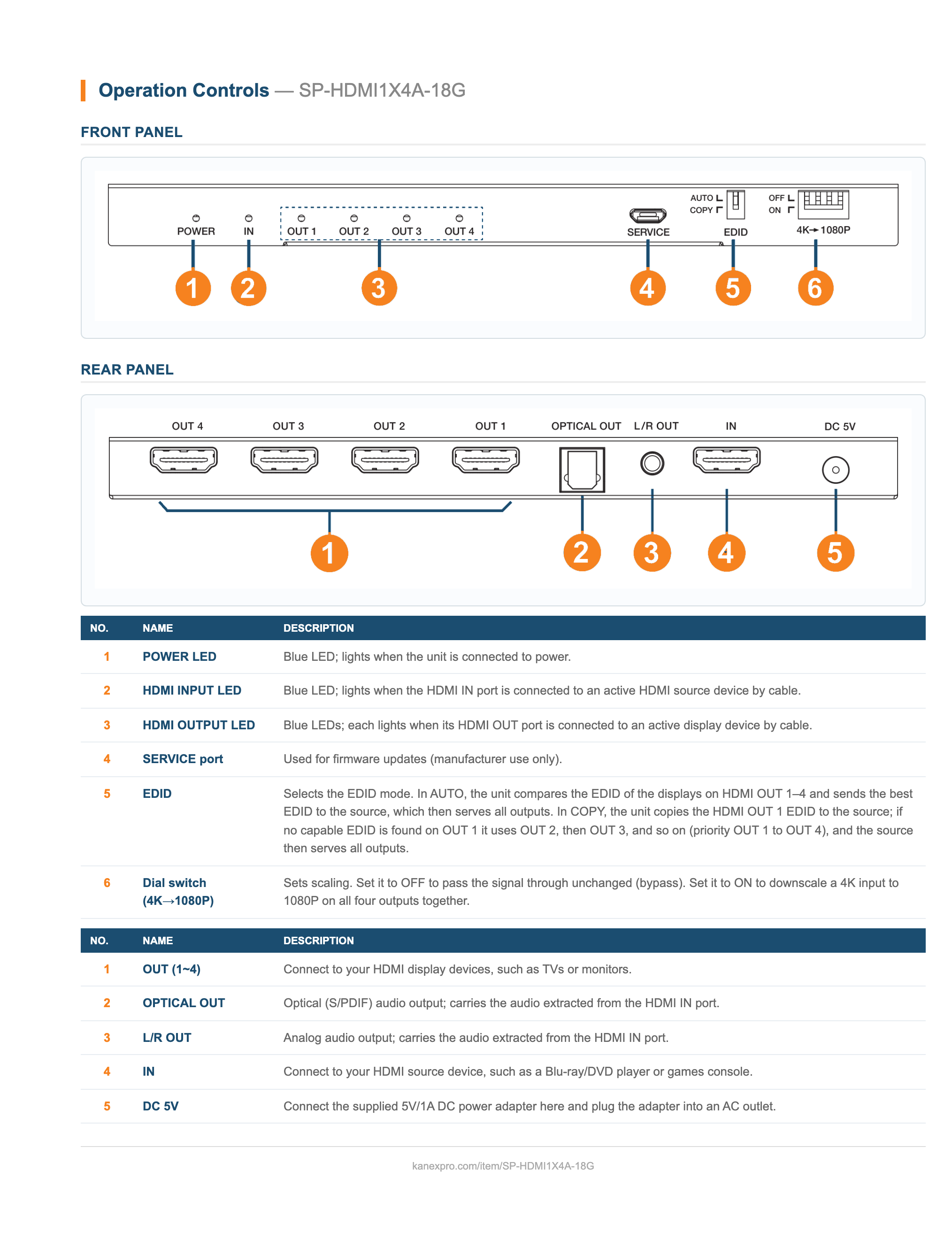
- Output bypass and 4K to 1080P downscaler, selected by a panel dial switch; the downscale switch is global to all four outputs.
- EDID set to COPY or AUTO mode via a panel dial switch. In COPY mode the unit copies OUT 1's EDID to all outputs, cascading to OUT 2, then OUT 3, then OUT 4 if no capable EDID is detected. In AUTO mode it compares OUT 1 through OUT 4 and outputs the best shared resolution.
- Analog audio output: PCM 2.0 on a 3.5mm stereo mini-jack.
- Optical S/PDIF output carries LPCM 2.0/2.1CH and Dolby Digital / DTS 5.1 bitstream.
- Metal enclosure with an external 5V/1A power supply.
Transcript
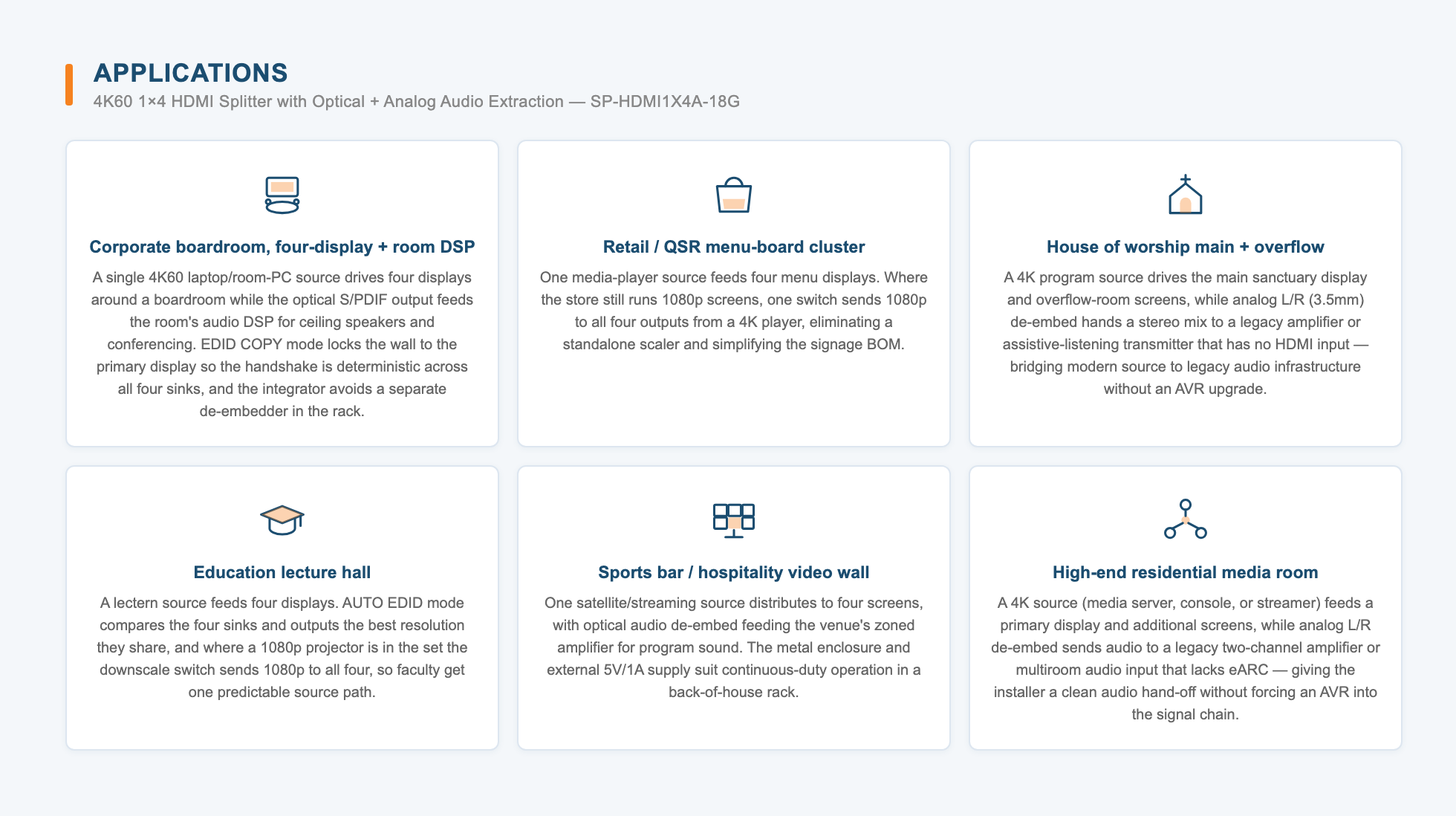
Hi, I'm Eric from KanexPro. This is our 4K60 one-by-four HDMI splitter: one source on four screens, and the sound out for the amp. HDMI 2.0b at 18 gigabits, 4K60 four-four-four, with HDCP 2.2. The sound leaves on optical and on a 3.5 millimetre stereo jack. Up front: an EDID switch, and a 4K to 1080p downscale. Here's how it connects. A Blu-ray player or a games console plugs into IN. OUT 1, OUT 2, OUT 3 and OUT 4 feed four displays, all the same picture. A 5 volt supply powers it. Next, the sound. The audio from the source on IN breaks out two ways at once. Optical carries Dolby and DTS to a surround processor. And the 3.5 millimetre jack sends stereo to a stereo amp. For one source, four screens, and an amp with no HDMI. Sports bars: one game on four TVs, optical to the amp. Houses of worship: overflow screens, stereo to assistive listening. Council chambers: every display the same, sound to the DSP. Homes: four TVs on one source, stereo to the old amp. Now, the key features. Two audio outputs at once: optical, and 3.5 millimetre stereo. Optical passes LPCM, Dolby 5.1, DD+ and DTS 5.1 to a surround processor. All four outputs get 4K60 four-four-four, with HDCP 2.2. One switch takes all four outputs to 1080p, for older screens and projectors. For integrators: EDID on a front switch, COPY from output one, or AUTO across all four. Spec it wherever four screens share a source, and the amp has no HDMI input. Thanks for watching. I'm Eric from KanexPro. See you next time.
| Video | |
| HDMI Compliance | HDMI 2.0b |
| HDCP Compliance | HDCP 2.2 and HDCP 1.4 |
| Video Resolution | 720p50/60Hz, 1080p50/60Hz, 4K2K 24Hz, 4K2K 30Hz, 4K2K@50/60Hz (4:4:4) |
| Color Space | RGB, YCbCr 4:4:4, YCbCr 4:2:2 |
| Color Depth | 4K60Hz: 8-bit; 1080p: 12-bit |
| Video Bandwidth | 18Gbps |
| Scaling | Bypass, or 4K to 1080P downscale (global to all four outputs) |
| EDID Modes | COPY, AUTO (panel dial switch) |
| Audio | |
| HDMI Audio Formats | LPCM, Dolby Digital/Plus/EX, Dolby TrueHD, DTS, DTS-EX, DTS-96/24, DTS High Res, DTS-HD Master Audio, DSD |
| Analog (L/R) Audio | PCM 2.0 |
| Optical (S/PDIF) Audio | LPCM 2.0/2.1CH, Dolby Digital 5.1, DTS 5.1 (bitstream) |
| Connections | |
| Input | 1× HDMI Type A (19-pin female) |
| Outputs | 4× HDMI Type A (19-pin female); 1× analog L/R (3.5mm stereo mini-jack); 1× optical S/PDIF |
| Power | |
| Power Supply | Input: AC 100–240V, 50/60Hz; Output: DC 5V/1A |
| Power Consumption | 3.5W |
| Physical | |
| Dimensions (W × D × H) | 7.09 × 2.44 × 0.55 in (180 × 62 × 14 mm) |
| Weight (net) | 0.50 lbs (227 g) |
| Housing | Metal enclosure |
| Color | Black |
| Environmental | |
| Operating Temperature | 32°F to 104°F (0°C to 40°C) |
| Storage Temperature | -4°F to 140°F (-20°C to 60°C) |
| Relative Humidity | 20–90% RH (non-condensing) |
| ESD Protection | IEC 61000-4-2: ±8kV (air-gap discharge), ±4kV (contact discharge) |
| Certifications | |
| Certifications | CE, FCC, RoHS |
| Package Contents | |
| Included | 1× 1×4 HDMI 2.0 Splitter |
| Included | 1× 5V/1A Power Adapter |
How much power does the SP-HDMI1X4A-18G draw?
What audio formats can the optical (S/PDIF) output of the SP-HDMI1X4A-18G carry?
Can the SP-HDMI1X4A-18G feed displays and a separate audio system at the same time?
Does the SP-HDMI1X4A-18G need a control system or network to run?
How do I make the SP-HDMI1X4A-18G downscale 4K to 1080p for my displays?
How do I set EDID during installation of the SP-HDMI1X4A-18G?
A display connected to the SP-HDMI1X4A-18G shows the wrong resolution. What can I try?
No picture reaches one of the displays on the SP-HDMI1X4A-18G. How do I isolate it?
How do I get sound to an amplifier or DSP that has no HDMI input?
Is this an 8K product?
Ask Claude, ChatGPT or Copilot about the SP-HDMI1X4A-18G: its specifications, your price, stock, and a draft order for you to place. Or wire the REST API into your quoting tool or ERP.