
8K HDMI 2.1 eARC Audio to Amplifier Adapter
De-embed ARC/eARC Audio to Any AVR — HDMI 2.1 Video Passes Through at Full 48Gbps
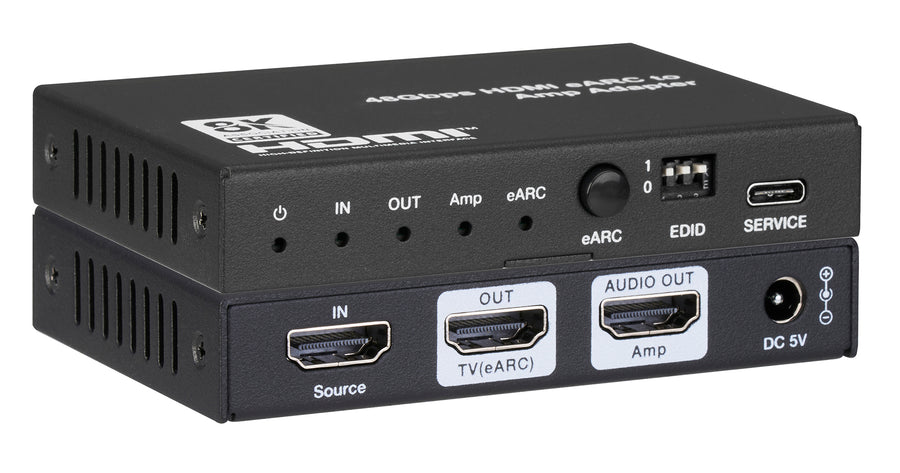
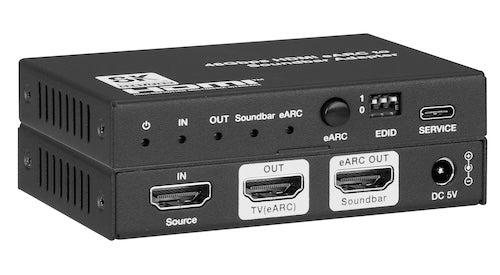
Bridges the gap between HDMI 2.1 eARC displays and legacy AV receivers by de-embedding ARC/eARC audio from any 8K-capable TV or HDMI source and routing it via HDMI directly to the amplifier — no AVR replacement required. Fully compliant with HDMI 2.1 and HDCP 2.3, supporting data rates up to 48Gbps FRL with zero video and audio latency.
Designed for CEDIA integrators specifying retrofit and new-build installations, the AUD-AMP-8K handles video resolutions up to 8K@60Hz and 4K@120Hz with full HDR pass-through (HDR10, HDR10+, Dolby Vision, HLG) and HDMI 2.1 protocols including VRR, ALLM, QMS, QFT, and SBTM. Eight DIP-switch EDID modes, CEC volume control, and a USB-C firmware update port ensure long-term serviceability in the field.
- HDMI 2.1 and HDCP 2.3 compliant with 48Gbps FRL and 18Gbps TMDS video bandwidth
- Supports video resolutions up to 8K@60Hz (4:2:0, 12-bit) and 4K@120Hz (4:4:4, 12-bit)
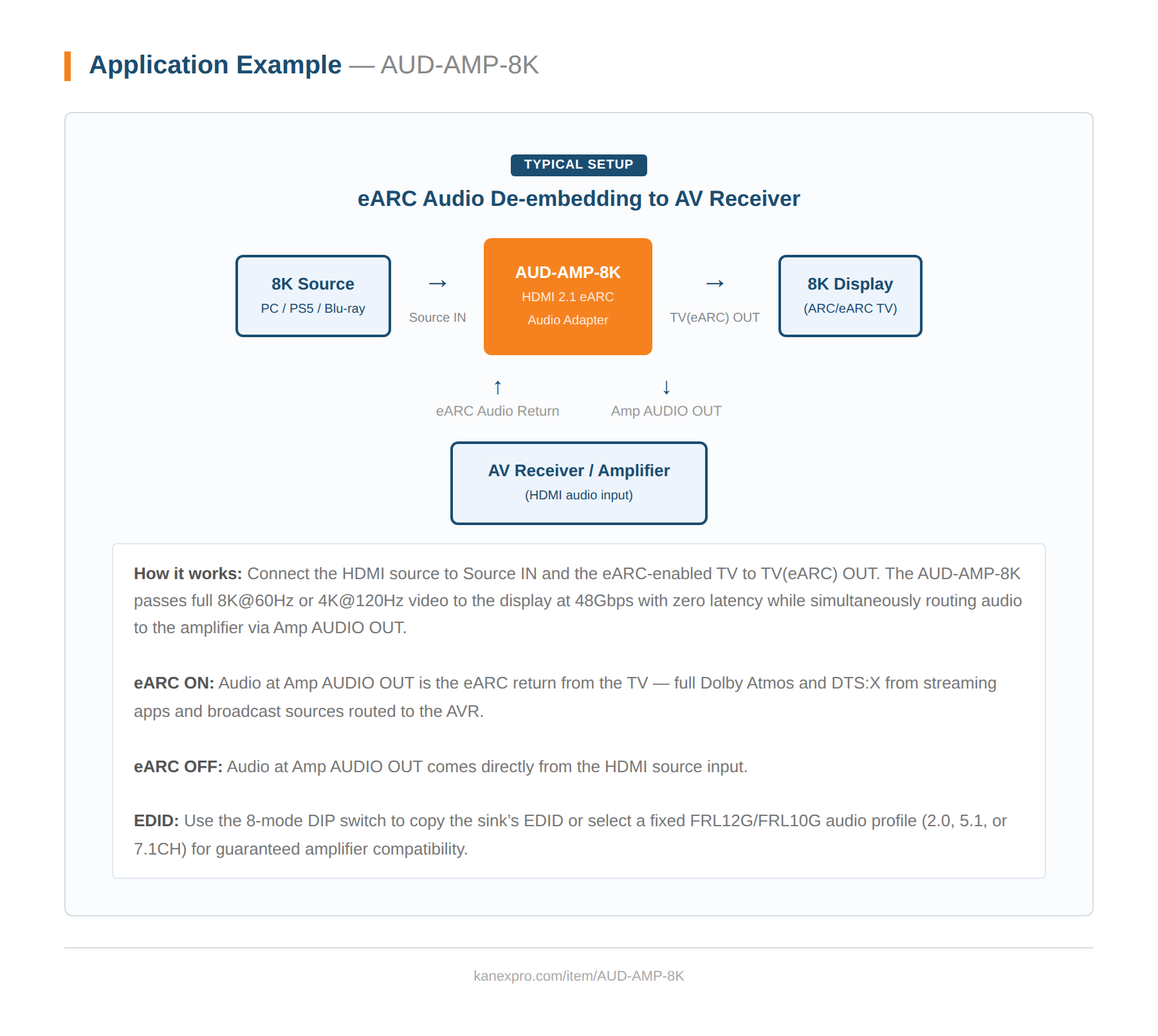
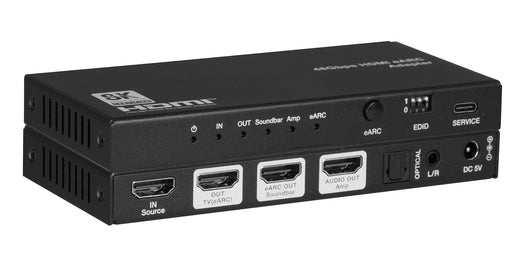
- De-embeds ARC/eARC audio from HDMI source input or TV ARC/eARC port to dedicated Amp AUDIO OUT
- Full audio pass-through: LPCM 7.1CH, Dolby TrueHD, Dolby Atmos, DTS-HD Master Audio, DTS:X
- HDR pass-through: HDR10, HDR10+, Dolby Vision, HLG; HDMI 2.1 protocols VRR, ALLM, QMS, QFT, SBTM
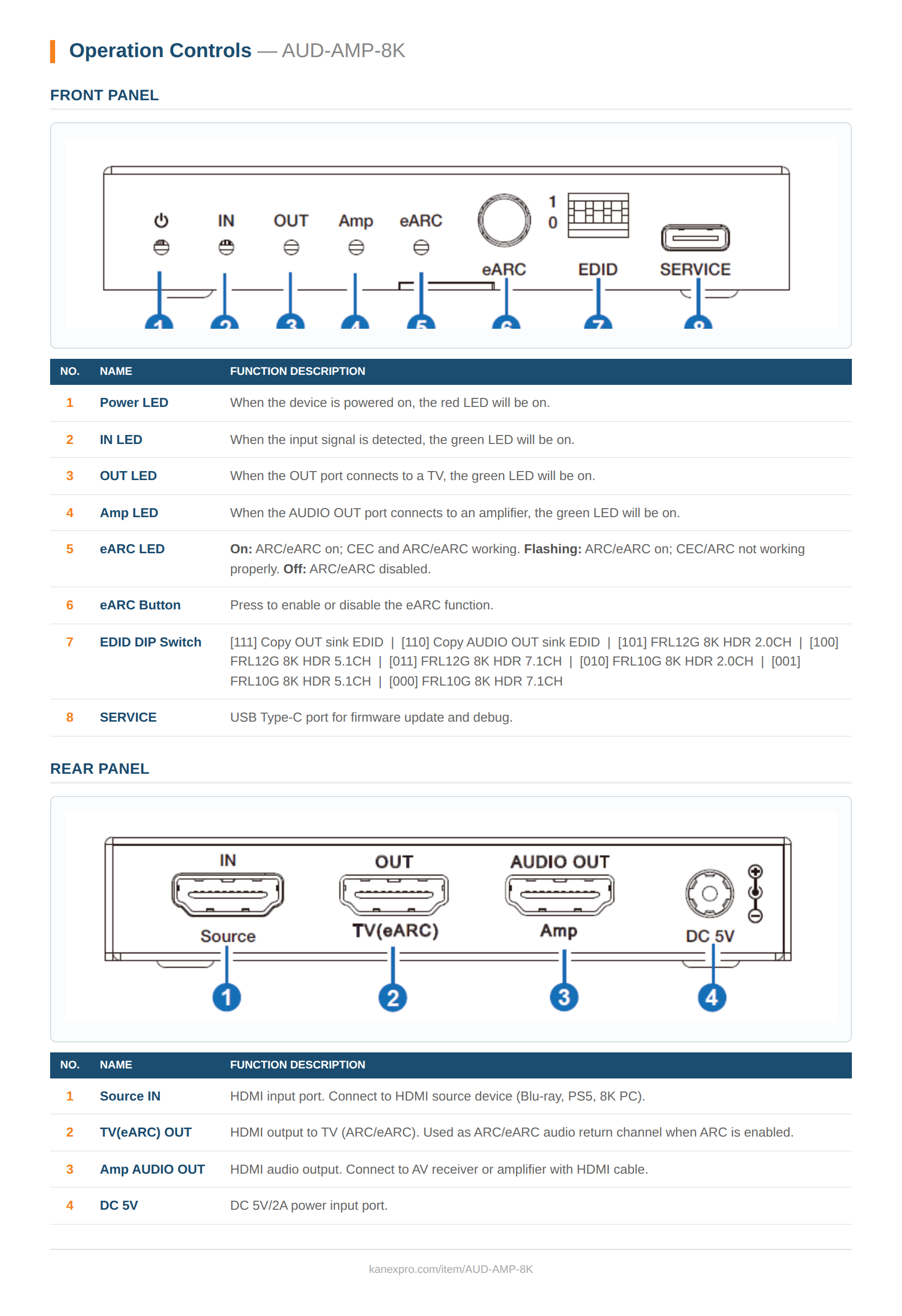
- Advanced EDID management via 8-mode DIP switch — copy sink EDID or select fixed FRL12G/FRL10G profiles at 2.0, 5.1, or 7.1CH
- CEC control and CEC volume control from TV to source and amplifier
- USB-C SERVICE port for field firmware updates and debug
- CE/FCC/UL certified 5V/2A multinational power supply included
| Specification | Value |
|---|---|
| Technical | |
| HDMI Compliance | HDMI 2.1 |
| HDCP Compliance | HDCP 2.3 |
| Video Bandwidth | 48Gbps FRL and 18Gbps TMDS |
| Video Resolution | Up to 8K@60Hz (4:2:0, 12-bit) / 4K@120Hz (4:4:4, 12-bit) |
| Audio Latency | No Latency |
| Video Latency | No Latency |
| Color Depth | 8/10/12-bit |
| Color Space | RGB 4:4:4, YCbCr 4:4:4, YCbCr 4:2:2, YCbCr 4:2:0 |
| HDR | HDR10, HDR10+, Dolby Vision, HLG |
| HDMI 2.1 Protocols | VRR, ALLM, QMS, QFT, SBTM |
| Audio Formats (IN/OUT) | LPCM, Dolby Digital/Plus/EX, Dolby TrueHD, Dolby Atmos, DTS, DSD, DTS-EX, DTS-96/24, DTS High Res, DTS-HD Master Audio, DTS:X |
| ESD Protection | IEC 61000-4-2: ±8kV (Air-gap) / ±4kV (Contact) |
| Connection | |
| Input | 1 × Source IN [HDMI Type A, 19-pin female] |
| Output | 1 × TV(eARC) OUT [HDMI Type A, 19-pin female] 1 × Amp AUDIO OUT [HDMI Type A, 19-pin female] |
| Control / Service | 1 × SERVICE [USB Type-C — firmware update & debug] |
| Mechanical | |
| Housing | Metal Enclosure |
| Color | Black |
| Dimensions | 95mm (W) × 68mm (D) × 18mm (H) |
| Weight | 178g |
| Power Supply | Input: AC 100–240V 50/60Hz | Output: DC 5V/2A (CE/FCC/UL certified) |
| Power Consumption | 4.5W (Max) |
| Operating Temperature | 0°C – 40°C / 32°F – 104°F |
| Storage Temperature | −20°C – 60°C / −4°F – 140°F |
| Relative Humidity | 20–90% RH (non-condensing) |
| Recommended HDMI Cable Length (HDMI IN / OUT) | |
| 8K@60Hz | 2m/6.6ft – 3m/10ft (Ultra HDMI 2.1) |
| 4K@60Hz | 5m/16ft |
| 4K@30Hz | 10m/33ft |
| 1080p | 15m/49ft |
| Certifications | |
| Power Supply | CE / FCC / UL |
| Package Contents | |
| 1 × | AUD-AMP-8K 48Gbps HDMI eARC Audio to Amplifier Adapter |
| 1 × | 5V/2A Multinational Power Supply (CE/FCC/UL certified) |
| 1 × | User Manual |
There is no audio from the amplifier - what should I check?
The IN or OUT LED is not lighting - what does that mean?
Why choose the AUD-AMP-8K over replacing an AV receiver?
How does the AUD-AMP-8K fit into an eARC-to-AVR retrofit?
The eARC LED is flashing - what does that indicate?
How does CEC control work on this adapter?
What HDMI and HDCP versions does the AUD-AMP-8K support?
What HDR formats and HDMI 2.1 protocols are supported?
What HDMI cable lengths are recommended for each resolution?
There is no video on the display - what should I check?

Ask Claude, ChatGPT or Copilot about the AUD-AMP-8K: its specifications, your price, stock, and a draft order for you to place. Or wire the REST API into your quoting tool or ERP.